Dull, Dehydrated Skin
Dullness is the vaguest of skin complaints and one of the more tractable, provided you work out what is actually scattering the light. Usually it is a combination of a worn-down barrier, surface build-up and uneven tone, and the three are not fixed in the same way.
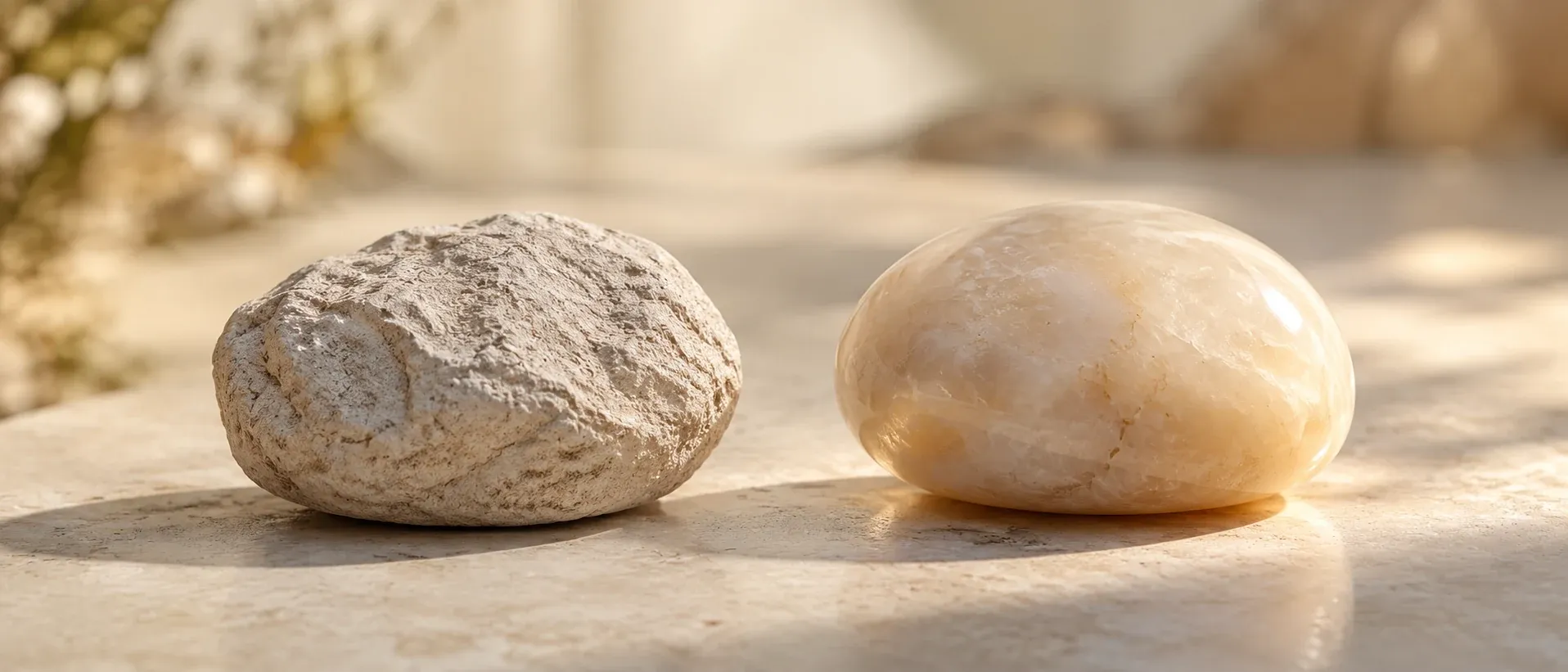
What makes skin look dull
Light reflects evenly off smooth, well-hydrated skin. Dullness is what happens when it does not, and several different things interrupt it.
A worn-down barrier. The outer layer holds water in. Strip it — with frequent exfoliation, stacked actives, hot water, aggressive cleansing — and the skin loses water, tightens and reflects light poorly. This is the most common cause among people who are actively trying to improve their skin.
Surface build-up. Dead cells accumulate and roughen the surface, which scatters light instead of reflecting it. It increases with age as natural turnover slows.
Uneven tone. Scattered pigment and background redness read as murkiness rather than as distinct marks, and they flatten the whole face.
Thinning skin with less dermal hydration. From the mid thirties onward the deeper layers hold less water and produce less collagen. This is the part that topical products reach least well.
Environment and lifestyle. Dry indoor air, air conditioning, long flights, alcohol, smoking, insufficient sleep and sun exposure all show here first. A trip involving flights and dry hotel air is itself a cause, which is worth knowing before blaming your skin.
How to tell which cause you have
Some self-observation is reliable here. After cleansing, does your skin feel tight for a while? That points to barrier and water loss. Run a fingertip across your cheek — roughness that you can feel points to surface build-up. Look at your face in daylight and ask whether it is the colour that looks uneven or the surface that looks matte; they are different complaints with different answers.
Then do an inventory. Write down every product you use and how often, including exfoliating pads and masks. People are consistently surprised by how much they are doing, and a two-week simplification is a free diagnostic test.
A consultation examines hydration and barrier condition, how much build-up there is, how much of the dullness is pigment and how much is texture, and how thin the skin has become. It should ask about your routine in detail, because the answer is often in it.
What addresses each cause
| What is causing it | What the treatment category is |
|---|---|
| A damaged barrier | Simplifying the routine first, supported by gentle clinic programmes |
| Surface build-up and roughness | Controlled exfoliation within a clinic programme |
| Dehydration in the deeper layers | Skin boosters in a course |
| Thinning skin and lost collagen | Rejuran or Juvelook |
| Uneven pigment and background redness | Laser toning and vascular work |
| Texture and fine lines alongside the dullness | Potenza or fractional laser resurfacing |
| Volume loss being mistaken for dullness | Filler — a different concern that often presents as looking tired |
If you are unsure whether your complaint is about quality or volume, the skin booster versus filler comparison sets out the distinction plainly.
What does not help
Adding more products. A longer routine on a compromised barrier prolongs the problem. Subtraction usually works faster than addition.
Scrubs and exfoliating pads several times a week. They produce a brief smoothness and a slower decline into the state you started from.
Lifting treatments. Ultrasound and radiofrequency devices address laxity. They do not make skin look brighter, and they are frequently sold to people whose concern is entirely surface quality.
Filler for a tired face, without looking at the skin. Sometimes volume is genuinely the issue. Often it is not, and volume added to poor-quality skin still looks poor-quality.
A single treatment booked for the week of an event, and nothing else. It works for the event. It is not a plan.
Whitening products used aggressively. Irritation is a cause of dullness, and strong lightening routines can produce exactly the flat, reactive look they were meant to fix.
Realistic timeline and how many sessions
A clinic programme improves how skin looks for several days to a couple of weeks. A booster course is typically three to four sessions two to four weeks apart, with the change building over one to two months and holding for several months afterwards. Regenerative injectables are slower still, and are judged at around two months.
Barrier repair from simplifying a routine takes two to six weeks and costs nothing. It is worth doing first, because it also makes everything else more comfortable and easier to judge.
What to ask at the consultation
- How much of my dullness is barrier, how much is surface, and how much is tone?
- What should I remove from my routine before we add treatment?
- Is a course the right answer for me, or would one session before my event do what I actually want?
- What is the maintenance interval after the course?
- Can I have the plan in writing so I can continue it at home?
FAQ
Is dehydrated skin the same as dry skin?
No. Dry skin lacks oil and tends to be a constant type. Dehydrated skin lacks water and can happen to oily skin too, often because the barrier has been worn down. The treatments differ.
How long does a single facial last?
Days rather than months. That has value before an event and it is not a change in the skin. Lasting improvement comes from a course and from what you do between sessions.
Will a booster course fix this permanently?
It improves hydration and texture for months and then needs maintaining. If the underlying cause is an over-aggressive routine, the course will keep being undone until that changes.
Does drinking more water help?
Being adequately hydrated matters generally, but drinking extra water does not correct a damaged skin barrier. Barrier repair is about what you stop putting on your face as much as what you add.